How AUTONET turns a household’s real needs
into a better experience and recurring revenue.
A better connection.
A reason to choose you again.
By Barbara Bessolo, Founder and CEO, DynamoEdge · Part two · Broadband Intelligence · October 2026
More than half of U.S. households reported a home internet problem in just 90 days. How do we ask them to spend more before we get that right?
A dropped video call. A bedroom with no signal. Another evening spent rebooting the router. Each unresolved problem gives a customer a reason to leave before we can earn the next sale.
By the time a customer calls to cancel the internet service, the competitor may already be connected. The screen still shows an active account, but the customer has moved on. We have all been there. The connection drops. The same problem returns. Eventually, we stop calling 1-800-I-don’t-have-internet and start looking for someone else.
The cancellation records the revenue loss, but it does not tell you when the service began to break. By then, you are watching your customer walk away and sign with your competitor.
I started DynamoEdge because I wanted operators to understand what was happening in the home before the customer had to call.
That same understanding can help them grow.
DynamoEdge’s patent portfolio: US 12,518,219 B2 · US 12,694,724 B2 · US 64/001,396 (provisional). Source: Parks Associates, 07/22/2026. U.S. survey; research sponsored by Plume.
A line can test healthy while a family’s video calls keep dropping. The cause may be weak Wi-Fi, an overloaded gateway or a repeated complaint nobody has linked to the network history.
Plume sponsored the Parks Associates research. More than half of U.S. households still reported an internet problem. To me, that says the industry has more work to do. Customers do not care whose AI we use. They want the connection to work.
Many companies say they do AI when they are selling you a third-party chatbot. For me, the test is simple: does the service improve? Otherwise, the bot will still have little to say.
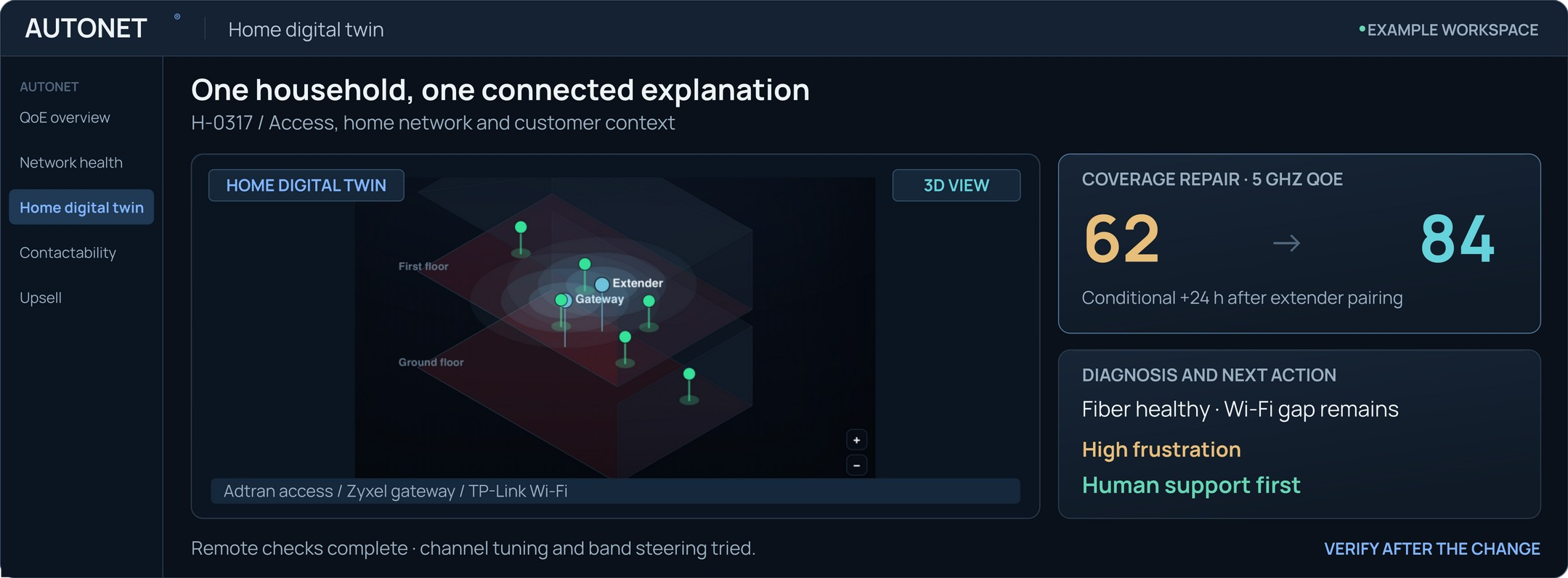
AUTONET joins subscriber identities, devices, network data and care history in one record. Its models can then see what is happening in the household. It uses sentiment analysis of customer interactions to understand how the customer feels and assess their level of frustration. Combined with the QoE forecast, this helps prioritize support and choose the right time for a useful offer.
Doing this across millions of homes is difficult. Different gateways and network systems must describe the same household. AUTONET gives them a common format, forecasts service quality and acts through controls the operator has approved.
Broadband Forum’s TR-098 and TR-181 data models give us a common language for devices, but on their own, they cannot tell us why a family is frustrated or what to do next. That is where AUTONET comes in.
Standards references: Broadband Forum TR-098 Internet Gateway Device Data Model · TR-181 Device Data Model.
We fixed the problems, now what? In part one, I wrote about our reported deployment results: QoE went up, and 15% of calls and 36% of technician visits were avoided. On AUTONET’s deployment at DIRECTV Latin America, Lucas Werthein said:
“The application of this cutting-edge technology accelerates our strategy to integrate artificial intelligence into the network. We are making the services provided to our customers even more efficient, adopting solutions that allow them to generate an experience of excellence.”Lucas Werthein, Vice President, DIRECTV Latin America · Published statement
The same measurements show where a customer needs more coverage, different equipment or a service that fits how they use their connection. That is a valuable conversation while the customer is still yours.
Would you blindly spend more money? If we ask a subscriber to spend more, we should be able to explain why. With AUTONET, their own connection gives us the answer. A faster package will not improve a weak signal in a bedroom.
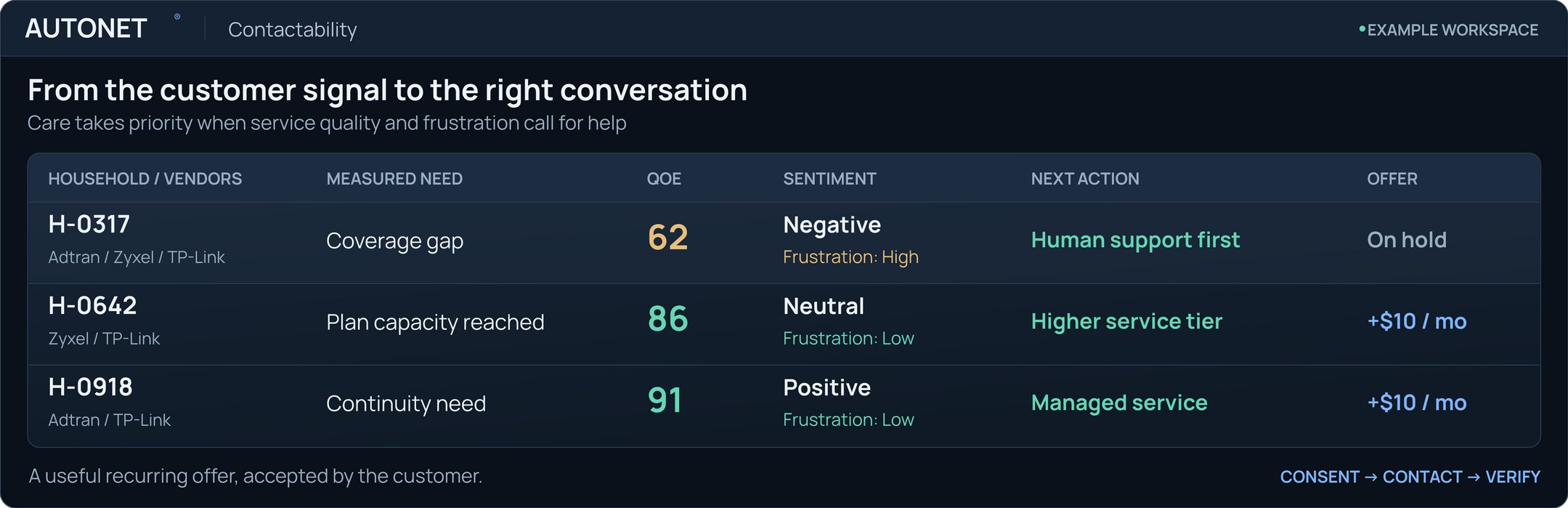
AUTONET explains what has been happening, what it has already tried and why the offer would help. After the upgrade, it checks whether the promised improvement arrived.
AUTONET helps network operators offer the right solution for each customer.
AI that saves cost can also generate revenue.
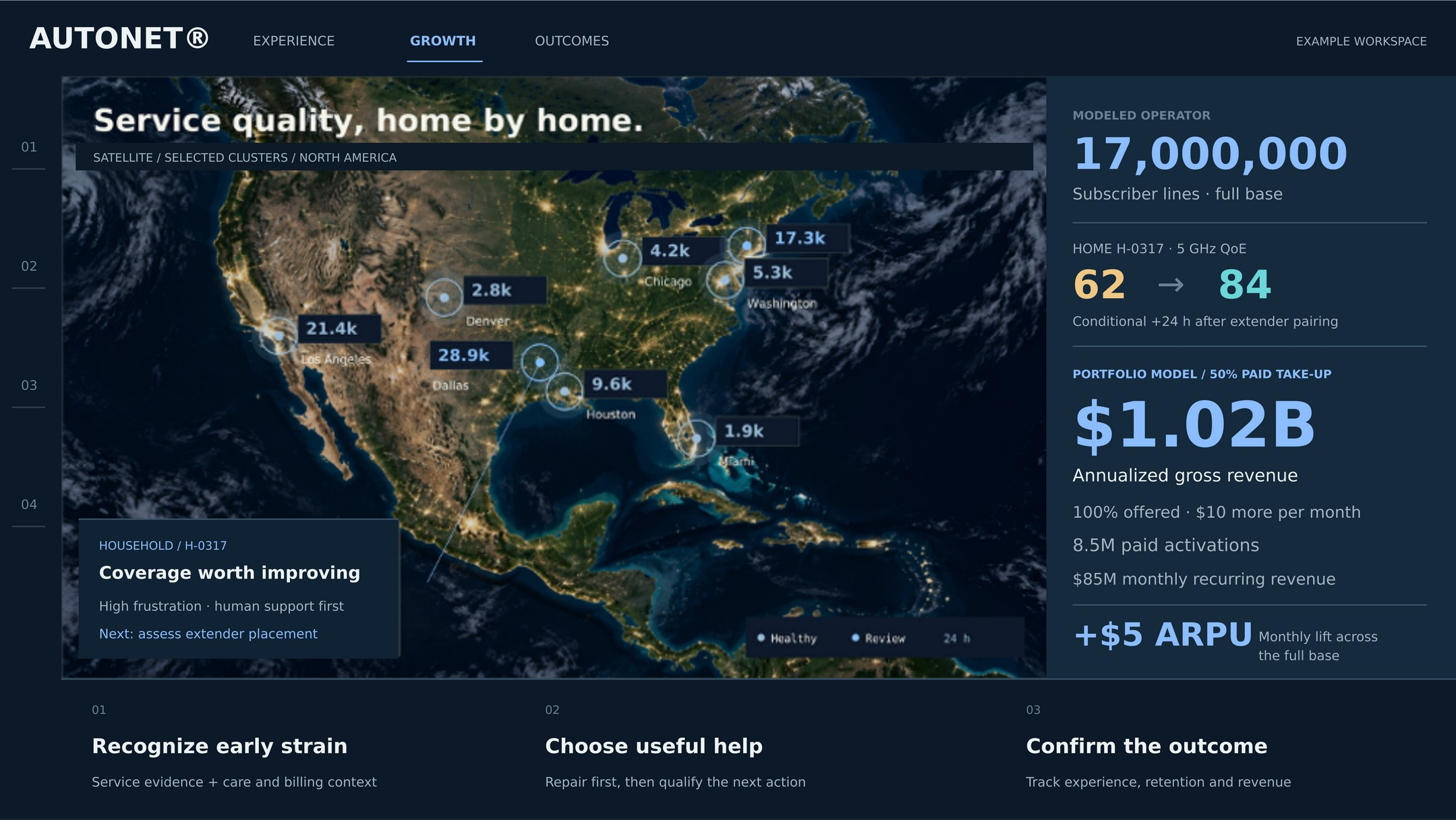
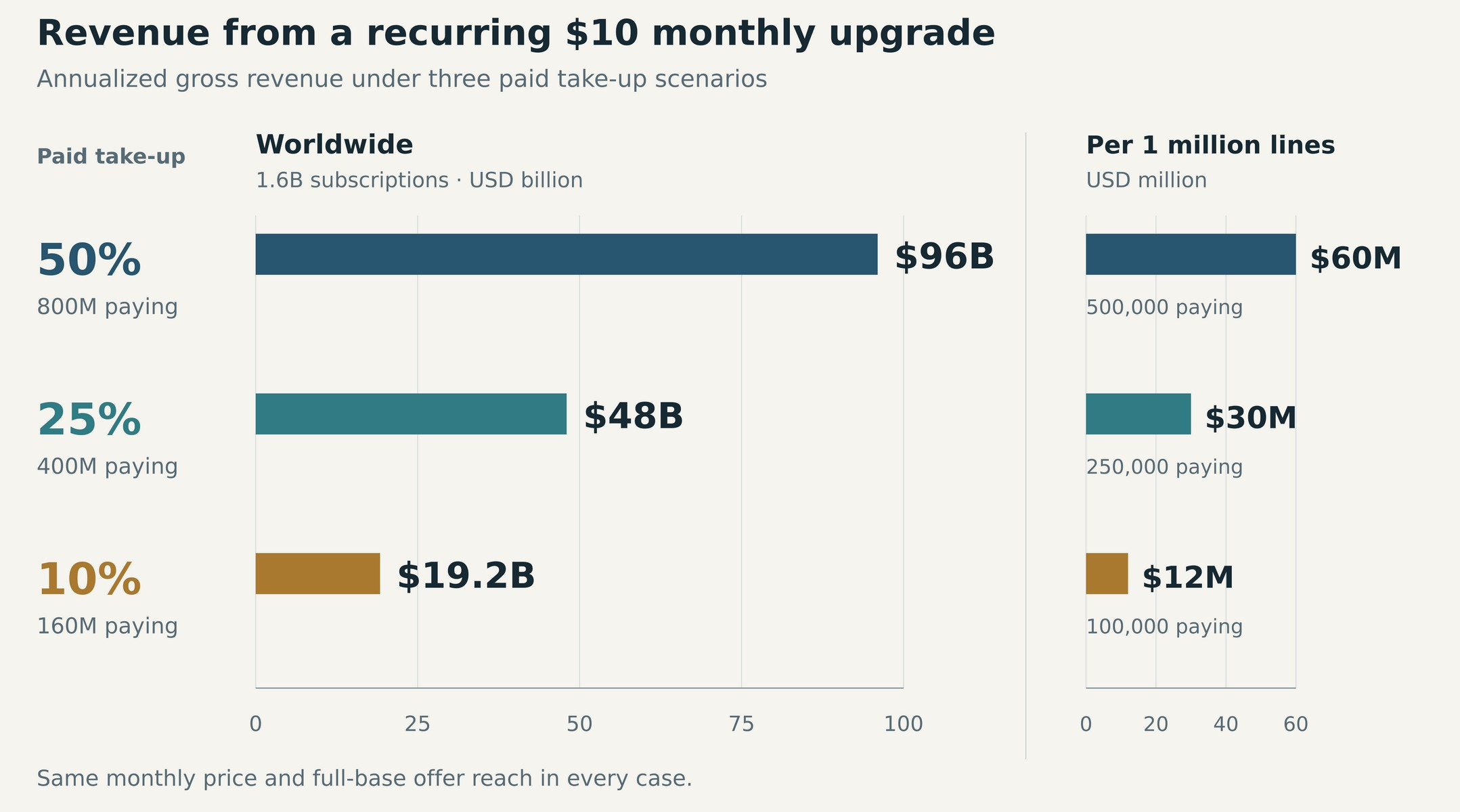
At $10 a month, the question is how many customers see enough value to pay for it. Start with ITU’s estimated 1.6 billion fixed broadband subscriptions. If an offer reaches them all and half pay $10 more a month, that is 800 million paying subscriptions and $96 billion in annualized gross revenue. At 25% take-up, it is $48 billion. Even at 10%, it is $19.2 billion.
AUTONET® has identified that about 10% of subscribers are ready for a specific new service upsell, and it can automate that upsell to deliver the service. If those subscribers take up a $10 monthly service, that represents a $19.2 billion annual opportunity for the broadband market.
Spectrum lists Advanced WiFi at $10 a month with its 500 Mbps plan; AT&T lists All-Fi Pro at $25 for eligible fiber customers. That gives us a market reference for a $10 monthly service. What customers will pay depends on where they live and whether the offer solves a problem for them.
Sources: ITU 2025 estimate · Spectrum Advanced WiFi · AT&T All-Fi Pro · Prices checked October 15, 2026.
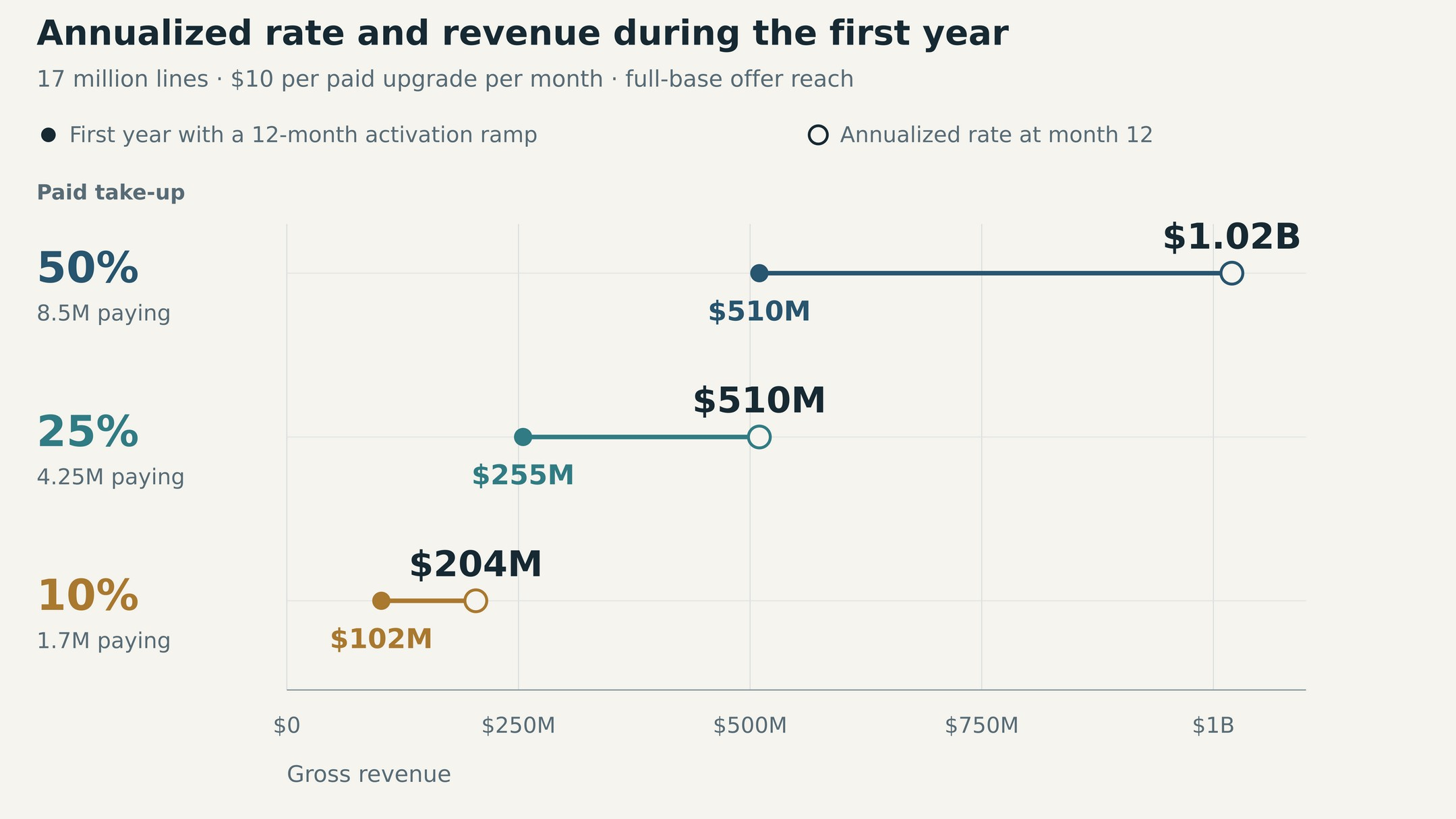
Take an operator with 17 million lines. If the offer reaches everyone and half pay $10 more a month for a recurring service, that is 8.5 million paid activations and $1.02 billion in annualized gross revenue. At 25% take-up, 4.25 million paid activations generate $510 million annually. At 10%, 1.7 million generate $204 million. The monthly ARPU increase across the full base is $5, $2.50 or $1, respectively.
AUTONET gives the telco the evidence to have that conversation.
For a generation, this industry has improved networks by replacing them. Faster silicon, denser spectrum, deeper fiber. That work still matters. But more capacity does not always mean a better experience at home.
If we lose the subscriber, what was all that investment for? We need to give their experience as much attention as the infrastructure itself.
AUTONET helps operators close that distance on the infrastructure they already have. When we ask a customer to spend more, we can show them why it would make their connection better.
Capacity was the last thirty years. Attention is the next ten.
We spent decades connecting the home. Now we can understand what it needs next. And that is the world DynamoEdge is leading for all of us.